A complex contamination profile in South African corn
Corn is a central raw material in South African animal feeds, but exposure to field and storage fungi creates an ongoing risk of contamination. The 2025-harvest survey showed co-occurrence in all analyzed corn samples, meaning that every sample contained more than one mycotoxin. This finding is especially relevant for pig production because commercial diets can expose animals to mixtures whose combined biological pressure may be greater than the effect expected from any single toxin considered alone.
The most prevalent compounds were deoxynivalenol (DON, 97%), fusaric acid (FA, 96%), beauvericin (BEA, 95%), and zearalenone (ZEN, 62%). The broad pattern was therefore strongly associated with Fusarium-related contamination, while fumonisins, moniliformin, ochratoxin A (OTA), and other metabolites added further complexity.
Emerging mycotoxins such as BEA and FA are not always part of routine monitoring, but their frequent presence matters because they may add to the total challenge experienced by pigs.
DON and feed intake
DON is especially important in the South African survey because it was detected in 97% of samples, with an average concentration of 1,649 ppb and a maximum of 13,128 ppb. In pigs, DON is closely associated with reduced feed intake and poorer growth. A diet can therefore affect performance before obvious clinical signs are seen. Variable DON concentrations among batches may also contribute to inconsistent feed consumption and uneven production results.
ZEN and reproductive risk
ZEN was present in 62% of samples, with an average of 84 ppb and a maximum of 789 ppb. Its estrogenic activity makes it particularly relevant for gilts, sows, and replacement animals. In a multi-toxin context, ZEN should not be assessed in isolation; the broader contamination profile and the sensitivity of the production phase must be considered when interpreting risk.
A multilayered approach with MYCORAID
MYCORAID is a multicomponent mycotoxin detoxifying agent designed for broad challenges. Its formulation combines mineral components for toxin adsorption, microbial components that support biological detoxification, yeast cell wall fractions that support the immune system, and herbal extracts that support liver function. This combination is relevant to South African corn because the survey was not dominated by one toxin alone.
To test the effectiveness of MYCORAID under practical conditions, a scientific experiment was conducted at the Freie Universität Berlin with weaned piglets in age of 25 to 66 days (Raj et al., 2025). The piglets were exposed to the common mycotoxins in South African corn: DON (1,500 ppb) and ZEN (900 ppb). This mycotoxin exposure had significant negative effects on the piglets’ growth parameters (feed intake, final weight, feed efficiency), blood count, inflammatory biomarkers, relative liver weight, and relative weight of the reproductive organs due to the estrogenic effect of ZEN. The use of MYCORAID mitigated the negative effects of DON and ZEN and brought most of the tested parameters back to control levels.
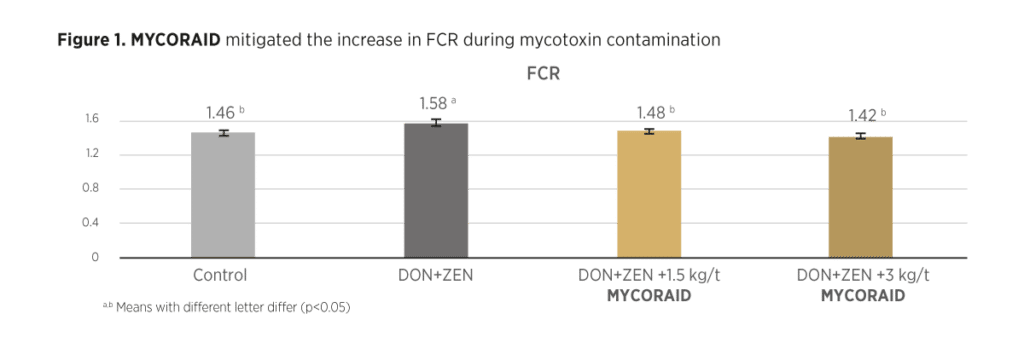
The total FCR for piglets aged 25 to 66 days fed the control diet was 1.46. Exposure to DON and ZEN significantly increased the FCR (1.58; +8.8%). The harmful effects of mycotoxins on the FCR were completely mitigated by MYCORAID in this trial (Figure 1).
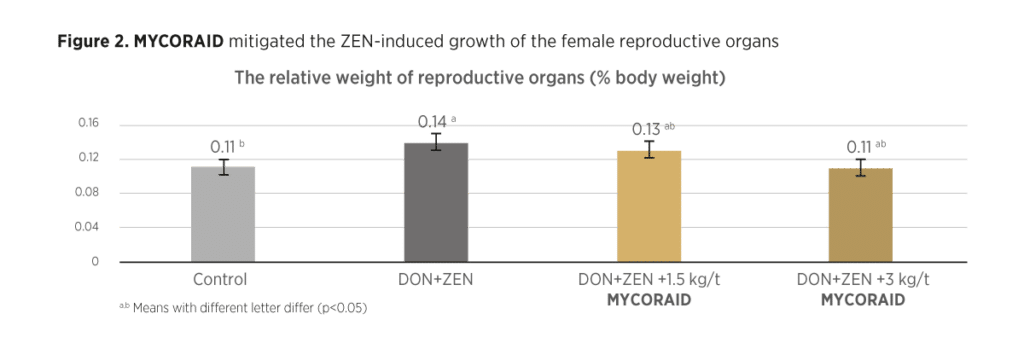
The total weight of the ovary, uterine horn, and vaginal vestibule was measured. The relative weights of the reproductive organs (% body weight) were significantly affected by exposure to ZEN. ZEN has an estrogenic effect, which leads to a change in the relative weights of the reproductive organs. Female piglets exposed to DON and ZEN showed a significant increase in the relative weights of the reproductive organs. MYCORAID reduced the weights of the reproductive organs and, at higher doses, achieved the relative weight of the control group (Figure 2).
These results show that MYCORAID was effective in detoxification of contaminants in the present trial, and that it supported piglet wellbeing.
Conclusion
The 2025 South African corn survey presents a multi-mycotoxin challenge for pig production. Every sample analyzed contained more than one mycotoxin, while DON, FA, BEA, and ZEN were especially prevalent. For pigs, this profile is relevant to feed intake, growth, immunity, reproduction, liver burden, and overall production consistency.
Effective control starts with representative sampling, regular feed analysis, and interpretation of the full contamination profile. Where exposure cannot be completely prevented, a multilayered strategy that combines adsorption, biological detoxification, immune support, and liver support can help protect pigs and maintain more consistent results. In maize-based South African production systems, managing co-occurrence rather than individual toxins is the central principle for practical mycotoxin risk management.