Beyond the feed: Managing the gut as an engine for productivity and health
Swine performance is often discussed in terms of genetics, production efficiency and reproduction. Yet, the gut itself drives these results. More than a digestive organ, it acts as a highly dynamic “factory”, a production system responsible for nutrient transformation, immune regulation and microbial metabolism. When this internal production line falls, every downstream process suffers substantially, affecting overall pig health and production performance.
At A&P Nutrition, we view the gut microbiome as the engine of this system. It determines how efficiently energy is transformed, how well pathogens are controlled and how resilient the animals remain under stress. Understanding and managing this ecosystem is not a luxury, it is essential for sustainable, predictable performance and demands a multifaceted nutritional strategy: one that protects, stabilizes and optimizes microbial function from different angles.
Safeguarding the base: mycotoxin control across all stages
Every production process starts with a stable base. In pig production, that foundation is safe feed. Mycotoxins are hidden stressors in the raw materials of compound feed that even at low, apparently subclinical levels, damage the gut lining and disturb the microbial communities. They can inhibit beneficial bacteria by shifting the milieu in the intestine in favor of opportunistic pathogens. Damage accumulates over time, ultimately hindering performance with various symptoms.
For example, the Fusarium mycotoxins deoxynivalenol (DON) and zearalenone (ZEN) can induce notable shifts in intestinal microbiota composition, including reductions in beneficial fiber-fermenting bacteria (e.g. Ruminococcaceae) and increases in other taxa during toxin exposure (Le Sciellour et al. 2020). Similarly, fumonisin B1 (FB1) has been shown to alter the porcine gut microbiome; chronic FB1 intake can decrease overall microbial diversity (Mateos et al. 2018). Even aflatoxin B1 (AFB1), primarily known for its hepatotoxicity, adversely affects the gut ecosystem, diminishing beneficial Lactobacillus populations while promoting the growth of opportunistic bacteria like Escherichia coli (Choi et al. 2025). These toxin-induced microbial shifts are thought to contribute to intestinal inflammation and nutrient malabsorption in pigs, highlighting that mycotoxin exposure can significantly influence gut microbiota and overall swine health.
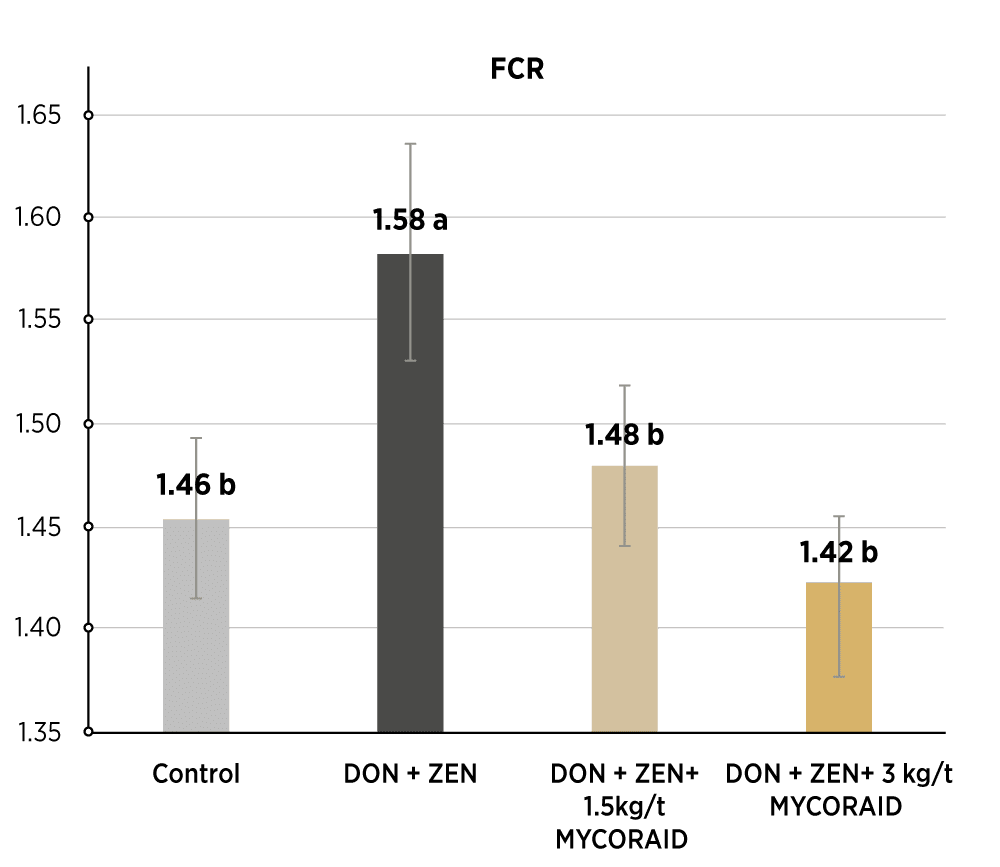
A sophisticated, multi-compound solution provides a multilayered approach to these threats. By combining adsorption, remediation and liver-supporting components, it reduces the bioavailability of multiple contaminants significantly. Beyond direct contaminant neutralization it supports mucosal integrity and maintains microbial balance, creating a stable foundation for the gut. Establishing a baseline starting on feed level is essential for nutritional interventions following to rely on an intact and resilient intestinal environment. In one trial in Germany, post-weaning piglets were challenged with a high dose of DON and ZEN for 42 days. Challenge increased FCR significantly, but the detrimental effects of mycotoxins on FCR were completely alleviated with inclusion of MYCORAID (Raj et al. 2025; Figure 1: Effect of a multi-component mycotoxin management product on alleviating FCR increase resulting from DON and ZEN challenge in piglets).
Multilayered mycotoxin management lays the groundwork for a functional “production” starting at the “raw material”, the feed. This stable foundation unfolds its full effect during the whole process. Although it is not aimed at stimulating growth directly, it mitigates losses and supports the proper functioning of downstream processes, including lactation and growth.
Feeding the system: Eubiotic lignocellulose as the fuel
Once the base is secured through feed safety, the next point of focus is the active support of the intestinal microbiome. A balanced microbiome is central to gut health and this, a central turning point to maintaining systemic health. This concept can be illustrated in sow management which not only aims at the sow’s own performance but also at creating the best possible
starting conditions for her offspring. Fueling the sow’s microbiome is a key factor to reach this goal. Nutritional strategies that support commensal microorganisms are critical. Dietary Fiber, though its importance is still often overlooked, is essential for microbiome management. However, the profile of the diet’s fiber fraction needs to be carefully selected to supply the
ideal combination of inert, soluble and slowly fermentable dietary fiber. This will supply the fiber fermenting bacteria with the ideal substrate to produce short-chain fatty acids (SCFAs), such as butyrate, the key energy source for enterocytes to uphold a stable intestinal barrier and modulate immune responses.
Eubiotic lignocellulose derived from stem wood and bark combines the mechanical benefits of inert fiber with the advantages of slowly fermentable components to optimize the sow’s gut environment. Unlike standard lignocellulose, eubiotic lignocellulose directly supports beneficial bacteria in the large intestine. As a result, OPTICELL has been shown to increase total
SCFA production in the hindgut of sows by 15% while the production of butyric acid, which is central to metabolic balance, gut integrity and wellbeing was increased by 29% relative to the control. Consequently, the gestating sows are calmer, show more resting and less stereotypical behavior and a higher feed intake in lactation. Thanks to an improved energy allocation, the farrowing duration is on average reduced by 16.4% or 41 minutes (all data available on request). That these benefits are pass on to the piglets is obvious from the start, with 5.6% more live-born piglets whose average birth weight is increased by 2.4%, leading to 3.2% higher weaning weights (Figure 2 – Overview on birth weight and weaning weight improvements in piglets of sows supplemented with eubiotic lignocellulose (agromed field and scientific trial data, 2007-2025)). Healthy sows build the next production phase on a balanced intestinal foundation.
Target acquired: porcine pathogens
During the pigs transition into the grower phase, when metabolic intensity and feed intake are high, the digestive system faces its highest microbial challenge. Even with optimized nutrition, swine herds face environmental pathogen challenges. Lawsonia intracellularis and Brachyspira hyodysenteriae can disrupt the epithelial renewal, provoke local
inflammation and destabilize the microbiome. These infections rarely act alone; in field conditions, co-infections are increasingly common, amplifying the severity of intestinal lesions and diarrhea. After taking overhand in the gut community, these infections reduce growth uniformity and feed efficiency, creating variability that impacts production economics. Conventional management has long relied on pleuromutilin-class antibiotics such as tiamulin and lincomycin, but the emergence of reduced susceptibility of bacterial strains and the global pressure to minimize the use of antibiotic demand viable nutritional alternatives.
A standardized blend of phytogenic substances can provide acute support under these challenging conditions but may also act as preventive measure to boost resilience. Its bioactive components modulate the immune system and negative impacts of pathogens on the microbial balance and gut barrier integrity. A recent field study (Wu et al., 2025) demonstrated that a blend of essential oils offered efficacy comparable to tiamulin/lincomycin against a combined infection of Lawsonia and Brachyspira. Over 7 weeks, pigs receiving essential oils showed a continuous reduction of L. intracellularis and B. hyodysenteriae, matching antibiotic-treated controls without withdrawal limitations (Figure 3 – The reduction of Lawsonia intracellularis and Brachyspira hyodysenteriae loads over time, comparing antibiotic and essential-oil-based feeding). Histological assessment confirmed preserved villus–crypt architecture and reduced mucosal inflammation in the test group, reflecting the additive’s protective actions. The results underline the dual potential of specific essential oils, targeting microbial imbalances while supporting epithelial integrity and performance. In practice, this means not only fewer clinical losses but also growth performance and a tangible step toward antibiotic-free production in swine herds.
Reducing inflammatory stress – the lignan effect
While each phase addresses specific functional needs, metabolic stability is a requirement to keep the engine “smooth” across all stages. So, the final step is maintenance and keeping the system efficient and resilient in the long term, like a “well-oiled machine”. Chronic low-grade inflammation triggered by various factors is one of the most underestimated productivity
drains: it diverts energy towards immune defense, increases oxidative stress and gradually alters the microbial balance by altering the environment in favor of opportunistic pathogens.
Wood lignans provide subtle yet pivotal support. With their anti-inflammatory and antioxidative properties they help maintain stability with several levers: reduce inflammatory pathway activation, help the gut lining to “stay in shape”, maintain microbial balance, all leading to a more stable, consistent performance across all stages. They act as the “engine maintenance” in the production process safeguarding performance by supporting metabolic balance even amid stressful conditions. In sows, metabolic stability ensures high reproductive performance as well as appropriate milk yield. In fattening pigs across stages feed conversion remains one of the most sensitive indicators of efficient production, even slight improvements reflect measurable savings and thus profitability. In a series of pig trials, a supplementation of wood lignans resulted in an improved feed conversion translating in steadier growth curves and less
fluctuations (Figure 4 – FCR in commercial pigs as influenced by wood lignan supplementation compared to control groups (average: -3.6%). *The figure indicates the duration of the trial.).
By combining all steps in the “chain” wood lignans contribute to all interventions to continue utilizing full capacities.
Conclusion: a new era in animal nutrition
Maximizing performance is no longer just about nutrition – it’s about protecting health, optimizing gut function, and minimizing invisible threats. In swine production, long-term performance depends on how well the gut, the engine, is maintained. Stressors which the animals face every day act like friction points in the system and just like a factory, the intestinal system needs to run smoothly, with each process working in sync to convert feed into performance of both reproduction and growth.
At A&P Nutrition we recommend a coordinated system approach, addressing each “production stage” as it is essential in achieving longevity in sows, as well as best carcass as well as best carcass parameters in finishing pigs. In the end, sustainable animal performance depends less on pushing limits and more on maintaining this internal machinery. A stable, resilient gut is not just a part of production, it is the production engine itself. By addressing external factors before they become challenges and providing advanced solutions to resolve the threats quickly and efficiently, A&P Nutrition benefits animal farming businesses by increasing their productivity while maintaining cost efficiency.
A&P Nutrition, the newly unified brand born from the strategic alliance of PATENT CO. and agromed under the RWA (Raiffeisen Ware Austria) umbrella, is redefining the future of animal nutrition. With decades of expertise now consolidated into a single, robust portfolio. At the heart of this transformation lies a clear mission: Improving animal performance. This is more than a slogan—it’s a customer-centric promise backed by innovation, transparency, and a deep understanding of species-specific needs.